A sustainable modular solution for building almost anything on water
Collaborators
Hubert Rhomberg
Location
Global
Category
Construction system, Housing
Timeline
2022 - ongoing

A growing acknowledgement of sea level rise and an increased risk of urban flooding has contributed to a sharp increase in interest in building on water, but current solutions, including polystyrene filled concrete foundations and plastic pontoons are inflexible, difficult to transport and highly unsustainable.
MAST has envisioned a new system of simple of flat-packed modules made from recycled reinforced plastic, that can be easily transported around the globe and assembled into countless configurations, providing a secure floating foundation. The system offers a sustainable and highly flexible solution for building almost anything on the water; from floating houses in Seattle, to floating campsites on Oslo fjord, to saunas on Hobart’s riverfront.
MAST is currently developing a prototype floating pavilion using the ´Land on Water´ system and is looking for like-minded partners interested in developing innovative & sustainable floating projects.

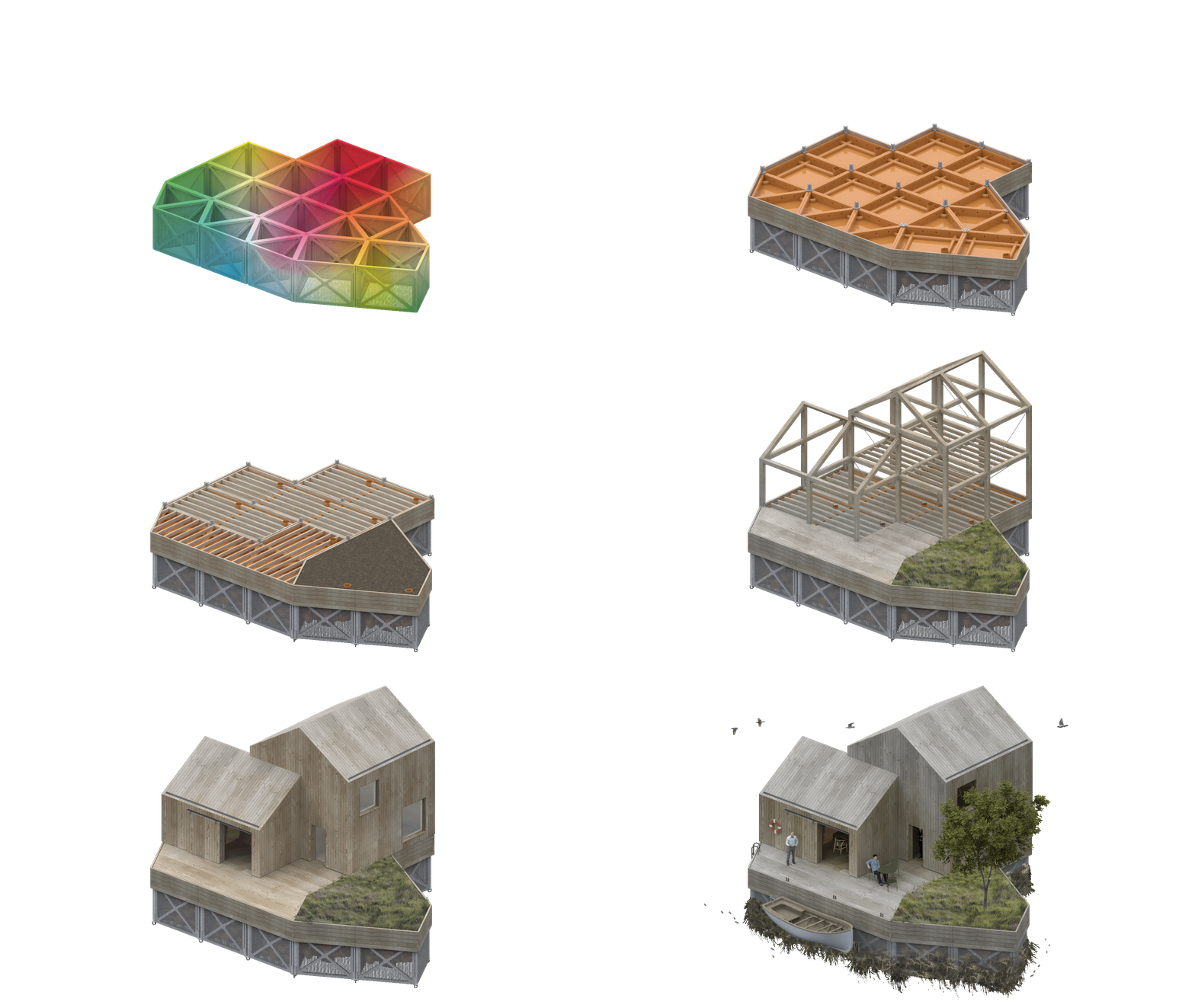
The system is based on simple, flat-pack modules made from reinforced, recycled plastic that can be easily transported around the globe and assembled into countless configurations. Providing a secure floating foundation for building housing and infrastructure. The system was inspired by gabion construction, an ancient technology which utilises mesh cages filled with rubble to create extremely sturdy, low cost foundations. In this case the concept is inverted; and the modular ‘cages’ are filled with locally sourced, upcycled floatation supporting the weight of any structure built on top. This has the unique advantage that floatation can be added or adjusted at any time if weight is added above.

Land on water promises a climate resilient and adaptable solution for the construction of new floating buildings but could also lead to an entirely new type of dynamic and organic off-grid floating community and an alternative to the large master-planned floating cities currently under development which repeat many of the mistakes made by urban planners in the middle of the 20th century.